
My 2026 Journey Through Free Gems of Washington D.C.
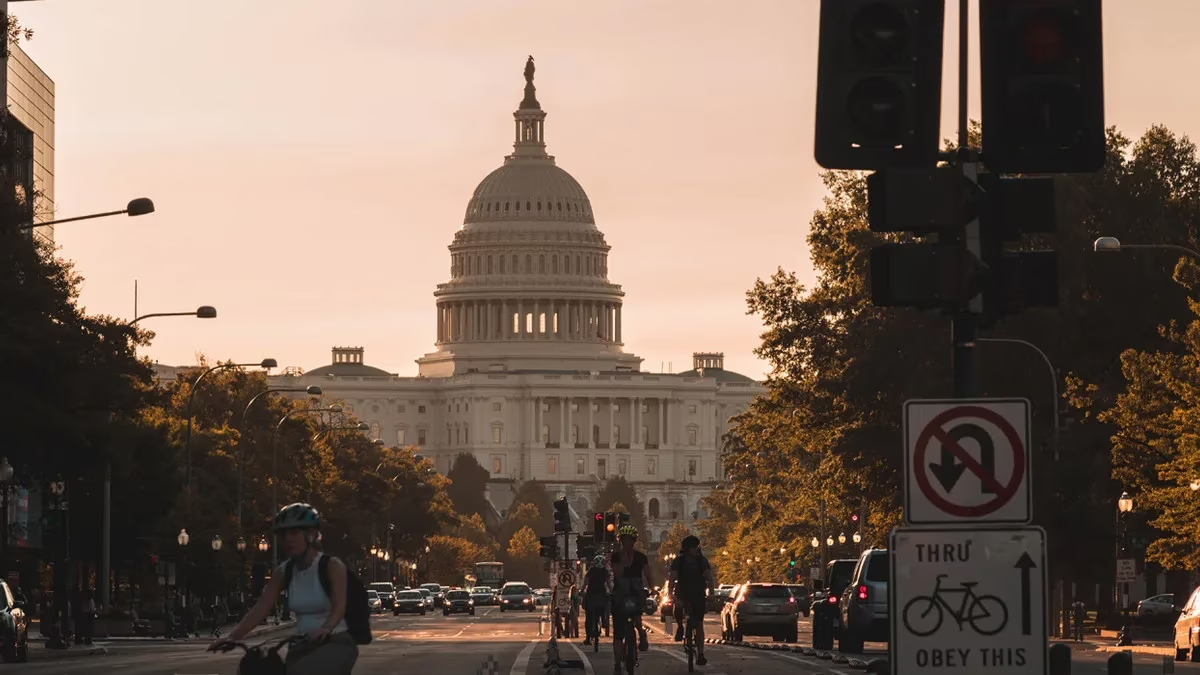
I stepped off the train at Union Station with a tight budget and a long weekend ahead of me. In 2026, when everything seems to cost more, I half‑expected the nation’s capital to chew up my wallet faster than a monument‑lined avenue disappears into the distance. But Washington, D.C. surprised me – it turned out to be one of the most generous cities I’ve ever wandered through. From the moment I glimpsed the Capitol dome against an autumn sky, I kept asking myself: why doesn’t everyone come here?
My first morning belonged to the Smithsonian’s National Zoo. I hadn’t expected to stand face‑to‑face with a giant panda without paying a single dollar. Entry passes are still required – even for infants – but the zoo remains gloriously free. I arrived at 8 a.m. sharp, just as the gates opened, and spent hours watching orangutans swing through the treetops and Asian elephants lumber across their habitat. Didn’t you ever wonder how 2,000 animals can be cared for in the middle of a metropolis? Walking those 163 acres, I felt like a kid again, and I kept asking myself: who says the best things in life aren’t free?
A short ride north brought me to Meridian Hill Park, a formal Italian‑style garden that feels like a secret whispered between the White House and the vibrant streets of Columbia Heights. The thirteen‑basin cascading fountain was still flowing when I visited in late October 2026 – one of the longest in North America – and the Joan of Arc statue gleamed in the afternoon sun. I sat by the reflecting pool and watched locals walk their dogs. Could there be a more peaceful spot to decompress after a morning of sightseeing? The park stays open until midnight in summer and 9 p.m. in winter, so twilight visits are pure magic.
The next day I escaped the city noise entirely at the U.S. National Arboretum. Over 451 acres of curated gardens, bonsai masterpieces, and woodland trails awaited me, all with free admission – no ticket needed. I joined a tree walk led by a botanist who shared how the arboretum contributes to landscape sustainability. Standing inside the National Bonsai & Penjing Museum, open daily from 10 a.m. to 4 p.m. except federal holidays in winter, I couldn’t help but marvel: isn’t it extraordinary that such living art is available to everyone? The place genuinely blurs the line between science and beauty, and I left with a new appreciation for the plants we so often ignore.
On my third day, I took the Metro to Arlington National Cemetery. The Tomb of the Unknown Soldier has drawn me since I was a teenager, and in 2026 it remains as powerful as ever. I arrived just in time for the hourly Changing of the Guard – a ceremony of absolute precision – and the silence that followed was heavier than any crowd I’d ever stood in. The cemetery is free to enter, open daily from 8 a.m. to 5 p.m. Wreath‑laying ceremonies still welcome school groups and the public, and I watched a dozen teenagers place a wreath with trembling hands. How could anyone visit this city and not feel the weight of sacrifice carved into these hills?
I saved the Library of Congress for a rainy afternoon, and it became my favorite indoor refuge. The Thomas Jefferson Building kept its doors open Tuesday through Saturday from 10 a.m. to 5 p.m., and timed entry passes are still required but free. Inside, I wandered through galleries of antique maps and Gutenberg Bibles before stepping into an interactive exhibit that let me “page” through digital manuscripts. The sheer scale of knowledge here – millions of items – made me wonder: what question could you possibly ask that this library couldn’t answer?
Of course, no trip would be complete without trying to visit the White House. Public tours are still free, self‑guided, and last about 45 minutes, but they remain a lottery of timing and luck. I had requested my tour through a member of Congress 45 days in advance, as the rules demand, and on a crisp Friday morning, I walked through the East Room and Blue Room with my own two feet. No press conference that day, but just standing there made me grin: who else has walked these floors, shaping history while I simply stared at the chandeliers?
My final evening was spent along the National Mall, tracing the monuments from the Lincoln Memorial to the Washington Monument. The reflection pool mirrored a salmon‑pink sunset, and the Jefferson Memorial glowed white in the distance. I didn’t spend a dime on tickets – these open‑air monuments are free around the clock – yet the experience felt priceless. Gazing at the Vietnam Veterans Memorial, I asked myself: how do you put a value on stories carved into stone?
Washington, D.C. in 2026 proved that a journey through American history, nature, and culture doesn’t have to drain your savings. From the roar of a lion at the zoo to the hush of a reading room, the city gave me far more than I gave it. If you ever doubt that free can be magnificent, just pack a comfortable pair of shoes and let the capital show you what it’s made of. Isn’t that the ultimate budget‑friendly adventure?
Comments